Worldwide, most mangoes are propagated from seed. Preferably, large and fully developed stones should be sown. The careful removal of the endocarp, releasing the seed, results in earlier and more uniform germination, producing seedlings with a straight stem and roots. However, this method is not feasible for commercial production of planting stock. Stones should be sown under shade and seedlings also require a certain amount of shade, those that are raised in nursery beds can be transplanted without much difficulty before the taproot has developed to any great extent. However, seedlings raised in baskets or containers are preferable. Selected varieties may also be propagated vegetatively by grafting the rootstock of the same or other Mangifera species and by budding.
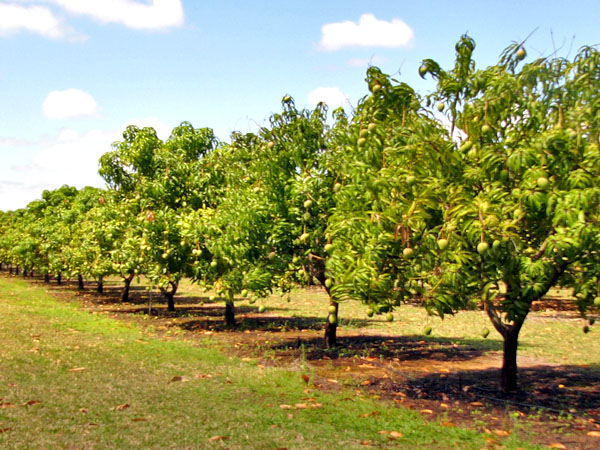
Irrigation in the first few years after planting promotes flushing so that tree size increases quickly. Irrigation also widens the scope for intercropping. For example, it can be done with papaya, banana, pineapple or vegetables during the establishment phase. When the trees are big enough to produce a substantial crop, irrigation is stopped or at least interrupted long enough to impose quiescence leading to flower initiation. Trees of most cultivars have a dense canopy and with a little weeding the orchard floor can be kept clean. To ensure good, balanced and productive growth, the mango trees should be pruned. The main stem of the hardy trees is allowed to grow to 1 m before being topped to facilitate well distribution of branches. In fruiting trees, pruning is confined to the removal of dead wood and branches broken or weakened by pests and diseases.
Mango seed storage behaviour is recalcitrant; there is complete loss in viability within 7 days in open storage at 30 0C. Viability can be maintained for 120 days with sub imbibed seeds stored at 15 0C; no loss in viability of excised embryonic axes on fast desiccation to 11.8% mc. Seeds are damaged by chilling to temperatures below 3-6 0C. They require no pretreatment, but nicking enhances germination. Fresh seeds germinate at temperatures between 5 and 40 0C with germination being most rapid between 25 and 40 0C. The germination rate of fresh stones is generally over 80% with the normal rate ranging from 60 to 90%. Sowing complete fruit or stones with the pulp attached delays germination by up to 7 weeks and germination rate is only 30-50%. Mature mango seeds have a high mc and cannot withstand desiccation; desiccation below 30% mc will kill them. Wet storage of stones at 15 0C is possible but germinating seeds develop roots about 5 cm long and shoots about 8 cm long after 6 months. There are up to 50 seeds/kg.