


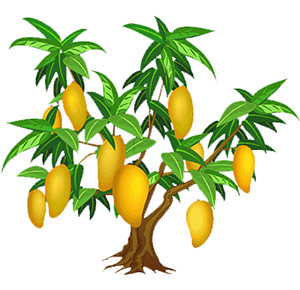
 Mango trees, grown from seeds are known as "seedlings" have a long straight bole. Tree is sympodially branched (Scarrone's model). On the other hand grafted trees are dwarf in stature with spreading branches. Isolated trees, getting sufficient space for their growth may differ in tree shape from the same variety grown in an orchard. Growth is stunted in shallow soils. Cultivars like 'Latra' and 'Creeping' which have a spreading growth habit can be trained as creepers. However, the shape of the canopy also depends on the space available for its development. The considerable variation in canopy characteristics of Indian mango cultivars has been observed.The eco-geographical factors also influence the compactness of the canopy, branching pattern and leaf component.
The grafted trees live only for 80 years or less whereas seedling trees live for over 100 years. One of the largest trees known, is that from Chandigarh (India), with a trunk of 3.5 m in diameter, limbs of 75 cm diameter, the crown spreading over 2250 m2 with an annual production of about 16000 fruits during peak years which is over 100 years old (Singh, 1960). Similarly a seedling tree measuring a spread of 125 ft. and a girth of 25 ft. has been reported to exist in Brazil (Popenoe, 1920).
Tree is medium to large (10-40 m in height), evergreen with symmetrical, rounded canopy ranging from low and dense to upright and open. Exudate of the live bark is transparent, a dark yellowish brown, drying brown, consisting of a resin mixed with a gum. The bark is usually dark grey-brown to black, smooth, superficially cracked or inconspicuously fissured, peeling off in irregular, rather thick pieces. The bark contains 78% resin and 15% gum in addition to tannic acid. The Twigs are not very thick, they are smooth, apically angular, glabrous, glossy and dark green.Terminal bud is small, enveloped by lanceolate acute bud scales.
The leaves are simple, exstipulate, alternately arranged, measuring 15-45 cm in length. The petiole varies in length from 1 to 12 cm, swollen at the base and grooved on the upper surface. The leaves are variable in shapes like oval-lanceolate, lanceolate, oblong, linear-oblong, ovate, obovate-lanceolate or roundish-oblong (Singh, 1960). The margin is sometimes slightly undulated and wavy, rarely twisted or folded. Depending on the variety and growth, the length and breadth varies from 12 to 45 cm and 2 to 12 cm respectively, secondary veins are quite prominent and in some of the varieties range from eighteen to thirty pairs. The leaves appear in flushes which are flaccid and pendulous when young. As the leaf grows, its colour changes from tan-red to green, passing through many different shades and becomes dark green at maturity and contain a good amount of mangiferin(xanthone). The phyllotaxy is usually 3/8 but as the leaves are arranged very closely at the tips they appear to be whorled. The apex ranges from acuminate to nearly rounded. The upper surface is shining and dark green while the lower is glabrous light green. The colour of young leaves generally vary from variety to variety, generally being tan-red, pink, yellow-brown in colour. The leaves contain fibrous tissue and produce a crackling sound when crushed and emit a strong smell of turpentine like odour, that may be absent in some cultivars. In India, it was obtained as "Indian Yellow" from the cow's urine. Cows were fed exclusively with mango leaves and ultimately excessive feeding of leaves lead to the death of the animal.
The pollen grains are of variable shapes, with the size ranging from 20 to 35 micron (Mukherjee, 1950; Singh, 1954). Small amount of pollen is produced by M. indica; the grains are sphaeroidal to prolatesphaeroidal, radially symmetrical, subangularin polar view, isopolar with a few giant triploid ones of up to 50 micron, they are 3-monocolporate, goniotreme, sides convex-subprolate; apertures equidistant and zonal; ecto-aperture extends slit-like from pole to pole.
Hermaphrodite and male flowers are produced in the same panicle, usually with a larger number of the later. The size of both male and hermaphrodite flowers vary from 6 to 8 mm in diameter. They are subsessile rarely pedicellate and have a sweet smell. Pedicels are very short or missing and they are articulate with a panicle branch of the same diameter which is often mistaken for the pedicel (Barfod, 1988). The lobes are ovate-oblong and concave. The calyx is usually fivepartite. The petals are in bud are imbricate and slightly contorted which are thin, yellowish and after expanding become horizontal, the upper half is irregularly and weakly reflexed, whereas they are free at their base. The corolla consists of five pale yellow petals (rarely four to eight), which are twice as long as the calyx and contain three to five ridges on the ventral side. The ridges are slightly dark. The upper half and the margin of the petal are white. On fading, the petals become pinkish. Between the corolla and androecium there is an annular, fleshy and five-lobed disc (Singh, 1960; Kostermans and Bompard, 1993). The androecium consists of stamens and staminodes, altogether five in number, of which usually one or rarely two are fertile and the rest are sterile. However, in cultivar Pico, three fertile stamens have been reported (Juliano and Cuevas, 1932). As many as ten stamens, which occur in other members of the genus, may also occasionally be found in the form of primordia only (Maheshwari, 1934). All the stamens are inserted on the inner margin of the disc. The position of the fertile stamen and pistil may be either parallel or oblique to each other (Naik and Gangolly, 1950). The fertile stamens are longer than the staminodes and are nearly equal to the length of the pistil. The colour of the anther is pink, which turns purple at the time of shedding. The ovary is sessile, one-celled, oblique and slightly compressed in its lateral aspect. It is placed on the disc. The ovule is anatropous and pendulous and shows one-sided growth. The style arises from the edge of the ovary and ends in a simple stigma, sometimes three carpels may develop in a flower.
The fruit varies considerably in size, colour, shape, presence of fibre, flavor, taste and several other characters. The formation of a small conical projection developing laterally at the proximal end of the fruit, known as the beak is the most characteristic feature of the mango fruit. It may be quite prominent in some, less so in others, while in some varieties it is represented merely by a dot. The fruit is more or less compressed, fleshy drupe. The shape of the fruit varies from rounded to ovate-oblong or longish, with the length varying from 2.5 to 30 cm depending on variety. The pistillate area of the fruit located near the base of the beak is known as the nak. The base may be depressed or elevated or may be intermediate. The skin is gland-dotted and at maturity its colour exhibit different mixtures of green, yellow and red shades. It may be smooth or rough.Its main irritating constituent has been identified as an allergenic urushiol, 5-heptadecenylreorcinol. The acrid juice with turpentine like smell present in the stalk or sometimes in the fruits is known as chenp in Hindi is due to myrcene and ocimene.
The tree forms a long unbranched tap root (up to 6-8 m and more) as well a dense mass of superficial feeder roots. The fibrous root system extends away from the drip line. Effective root system of an 18 years old mango tree may observe a 1.2 m depth with lateral spread as far as 7.5 m (Bojappa and Singh, 1974). Feeder roots develop at the base of the trunk or slightly deeper; these produce anchor roots and sometimes a collection of feeder roots develop above the water table.
The inflorescence is a narrowly to broadly conical panicle up to a 45 cm long depending upon cultivar and environmental conditions during its development depending upon cultivar and environmental conditions during its development. It is usually bracteate but may sometimes be ebracteate. The inflorescence is pseudo-terminal, originating from a bud, together with the new leafy sprout; there are cultivars with lateral inflorescence. The bract if present, is leafy, elliptical and concave. The panicle bear 500-6000 flowers of which 1-70% are bisexual, remaining are male depending on the cultivar and temperature during its development. The colour of the panicle may be yellowish-green, light green with crimson patches or with crimson flush on branches. It is generally pubescent but sometimes glabrous. The branching of the inflorescence is usually tertiary rarely quaternary but the ultimate branching is always cymose (Singh, 1960).
The genus Mangifera belongs to the order Sapindales in the family Anacardiaceae which is a family of mainly tropical species with 73 genera (c. 850 species) with a few representatives in temperate regions. The other distant relatives of Mangifera are cashew (Anacardium occidentale), gandaria (Bouea gandaria), pistachio (Pistacia vera), marula (Sclerocarya birrea), ambarella (Spondias cytherea), yellow mombin (Spondias mombin), red mombin (Spondias purpurea), imbu (Spondias tuberosa), dragon plums (Dracontomelum spp.) kaffir plum (Harpepbyllum caffrum), etc. Malaysia has been considered as the phytogeographic region extending from the Malay peninsula south of the Kangar-Pattani line to the Bismarck archipelago east of New Guinea (Whitmore, 1975). It is also a family well known for the dermal irritation produced by some of its members, including some Mangifera spp. whose resinous sap may induce allergic reaction. Apart from edible fruit Anacardiaceous species also yield other valuable products like wood, gums and resins, wax and varnishes and tanning materials
The Genus Mangifera L
The genus Mangifera consists of 69 species and mostly restricted to tropical Asia. The highest diversity occurs in Malaysia, particularly in peninsular Malaya, Borneo and Sumatra representing heart of the distribution range of the genus. The natural occurrence of all the Mangifera species extends as far north as 270 latitude and as far east as the Caroline Islands (Bompard and Schnell, 1997). Maximum species diversity exists in western Malaysia and about 28 species are found in this region.
Wild mangoes occur in India, Sri Lanka, Bangladesh, Myanmar, Sikkim, Thailand, Kampuchea, Vietnam, Laos, southern China, Malaysia, Singapore, Indonesia, Brunei, the Philippines, Papua New Guinea and the Solomon and Caroline Islands. Mangifera bompardii, M. dongnaiensis and M. orophila are mainly found in sub-montane forests above 1000 m and occasionally up to 1500-1700 m above sea level whereas few species like M. caloneura, M. collina, M timorensis, M. zeylanica are acclimatized to seasonally dry climates in deciduous or semideciduous forests. M. sylvatica and wild M. indica can be found in Sikkim and southern China at altitudes of 600-1900 m above sea level.
Mangifera species are mostly distributed below 300 m but can occur at 600-1900 m above sea level. The species is found as scattered individuals in tropical lowland rain forests on well-drained soils. Most of the species (c. 44) are found on well drained soils, periodically flooded (9 spp.) and species like M. gedebe, M. griffithii and M. parvifolia occur in certain type of swamp forests.