


Maturity indices for Carabao mango If flower induction is done in early season i.e. in October, November and December that allows fruits to mature longer. This requires from 120 to 130 days after flower induction before harvest. If induction is done in season January, February and March fruits mature faster and these requires only 105 to 115 days before harvest. If trees are not induced (natural flowering), fruits are usually harvested 82 to 88 days after full bloom.
Other distinguishing features of matured fruits are:
Lately, flotation method using 1.0% salt solution is used to determine maturity:
If accelerated ripening with carbide is done to minimize problems due to disease, it would be much better to simply subject the fruits to HWT (52° to 55° C for ten minutes), followed by hydro cooling and air drying before packing. Place liners, such as newsprint, inside the container to help conserve some of the heat which can accelerate ripening. Carbide at the rate of 5-6g/kg fruit is used by many retailers to hasten ripening. The carbide is first wrapped in newsprint and enclosed with the fruits in a kaing. Since there are some questions on the safety of the use of carbide and its effect on fruit quality, it would be best to let the mangoes ripen naturally to a little more than half-ripe before treating with 1.25g/kg fruit. With Carbide, fruits ripen four to five days from application. However, carbide must never be used to force immature fruits to ripen. Although yellowing is improved by carbide, the quality of pulp is inferior. There is no substitute for natural ripening. The aroma as well as the fruit quality is enhanced.
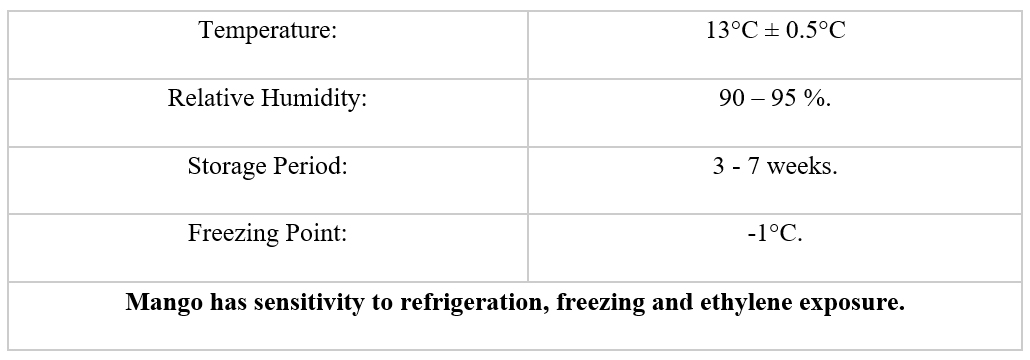
Low temperature storage effectively extends the green life of mango. However chilling injury (CI) is a problem which can be encountered at temperature below 12.5 °C. Post harvest heat treatment usually increases the sensitivity of mangoes to chilling injury at low temperature. Mangoes exerted to Japan, Australia, USA, Korea and New Zealand have to undergo disinfestations treatments against fruit fly to meet the quarantine standards of importing countries. Japan subjects Philippine mangoes to vapor heat treatment (VHT). The treatment consists of heating the fruits in a chamber with vapor-saturated air until the fruit pulp reaches a temperature of 46 °C. This temperature is maintained for 10 minutes, after which the chamber is ventilated. The whole process usually takes 4 hours. The extended heat treatment is another disinfestations method that can cause internal breakdown, where portions of the pulp assume a tough leathery texture and a spongy appearance. Early season fruits are susceptible to this disorder, particularly the immature ones. Internal breakdown can be reduced by culling immature fruits, delaying VHT until fruits show the faintest yellow peel and cooling fruits immediately after treatment. The HWT at 52 to 55 °C for disease control makes fruits more tolerant to VHT, if applied four to eight hours before treatment.
This is a local basket made out of bamboo with a capacity of 30-36 kg. It is usually used because it is cheaper and readily available. To prevent bruising of fruits, it is lined with newsprint, perforated polyethylene or polypropylene sheets. Avoid using leaves because it could cause the rotting of fruits. Since kaings could not be piled or stacked during transport, wooden planks or a similar structure be placed on the floor to bear the weight of the basket and to avoid compression damage. Overfilling should be avoided to minimize compression damage.
Wooden crates have been designed for mangoes but these are more expensive and less readily available than kaings. Wooden crates are rigid and provide adequate protections against injury, particularly during stacking. However, the inner surface of the crates is easily contaminated and hard to clean, thus limiting the use of the crates. Use of newspapers to line crates is important.
These have a capacity of 12 kg and are used to transport mango fruits from Guimaras to packinghouses in Metro Manila. These are designed to serve as cell packs with horizontal divider between two layers of fruits.
Some exporters provide their supplier with returnable plastic crates. This is the best container for local handling of mangoes. These provide adequate ventilation, are durable, stackable, easy to handle, clean and do not require the use of liners. The high initial cost will eventually be compensated since the containers are durable (long lasting). These also reduce injury transportation.