


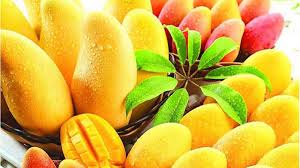
 Common mango (Mangifera indica L.) originated as an allopolyploid and its native home was suggested as Eastern India, extending from Assam to Burma or possibly further in the Malay region (Popenoe, 1920). Based on the detailed study of the history, phyto-geographical distribution of allied species, fossil records and evidence of numerous wild and cultivated varieties in India. Mukherjee (1951) considered origin of genus Mangifera probably in Burma, Siam, Indo-china and the Malay peninsula but the birth of common mango is in Assam-Burma region and not in Malay. The superior types were introduced into Malay region from India. It is also an evidence of its origin in India.
Indo-Burma region was also suggested as the centre of origin of mango by Vavilov (1926).However, the origin of Mangifera indica has been a matter of speculation for many years. The fossil record described by Seward (1912) provides few clues, as the only fossil bearing the leaf imprint of M. pentandra has ever been found in Assam. According to De Candolle (1884), 'It is impossible to doubt that it is a native of South Asia or of the Malay archipelago, when we see the multitude of varieties cultivated in those countries, the number of ancient names, in particular a Sanskrit name and its abundance in the gardens of Bengal, of Deccan peninsula and Ceylon, even in Rheede's time (i.e., 1683).
On the basis of ancient accounts of travellers and the written historical records, it was believed for many years that mango must have originated in India and spread outward from there to Southeast Asia and thence to the New World and Africa as northeastern India is at the northernmost edge of the distribution of the Mangifera species (Mukherjee, 1997), Hooker (1876) suggested that mango might have been naturalized in India. Mukherjee (195l) suggested that Mangifera indica first appeared during the Quaternary period. Bompard and Schnell (1997) also suggested that great species diversity of Mangifera in Malay Peninsula, Borneo and Sumatra, the available evidence points to a Sudanic origin for the genus. This however must not minimize the particular importance to the region stretching from Myanmar to Indo-China as another centre of diversification, as attested by a range of species belonging the section Euantherae (section including M. calunera, M. cochinchinensisand M. pentendra ). Further M. indica apparently originated in region on western border of the secondary centre of diversification as mentioned above.
Truly wild common mango trees have been recorded in Bangladesh (Chittagong Hills), northeastern India (Assam valley) and Myanmar. Owing to its cultivation and dissemination for thousands of years, in India semi-wild trees can be found in the forests throughout the subcontinent. On the basis of taxonomic and recent molecular evidence it is now apparent that that mango probably evolved within a large area including north western Myanmar, Bangladesh and northeastern India (Mukherjee, 1997). Based on the recent findings (Mukherjee, 1997 and Bompard and Schnell, 1997), the centre of origin and diversity of the genus Mangifera is now firmly established in Southeast Asia.