


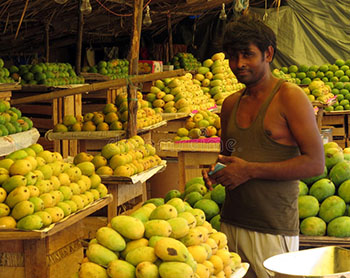
 India occupies top position in total production among mango growing countries of the world.
India's Export of Mangoes has been increased by Rs. 209 crores in 2010-11 from Rs 142 crores in 2006-07, representing a growth of 47%. The major 5 importing countries of India's Mangoes were UAE, Bangladesh, UK, Saudi Arabia, and Nepal respectively; these countries alone comprises of around 87% of India's total export of Mango. The major importing regions of India's Mangoes were WANA, South Asia and EU-27 countries respectively. The details of export are given below:
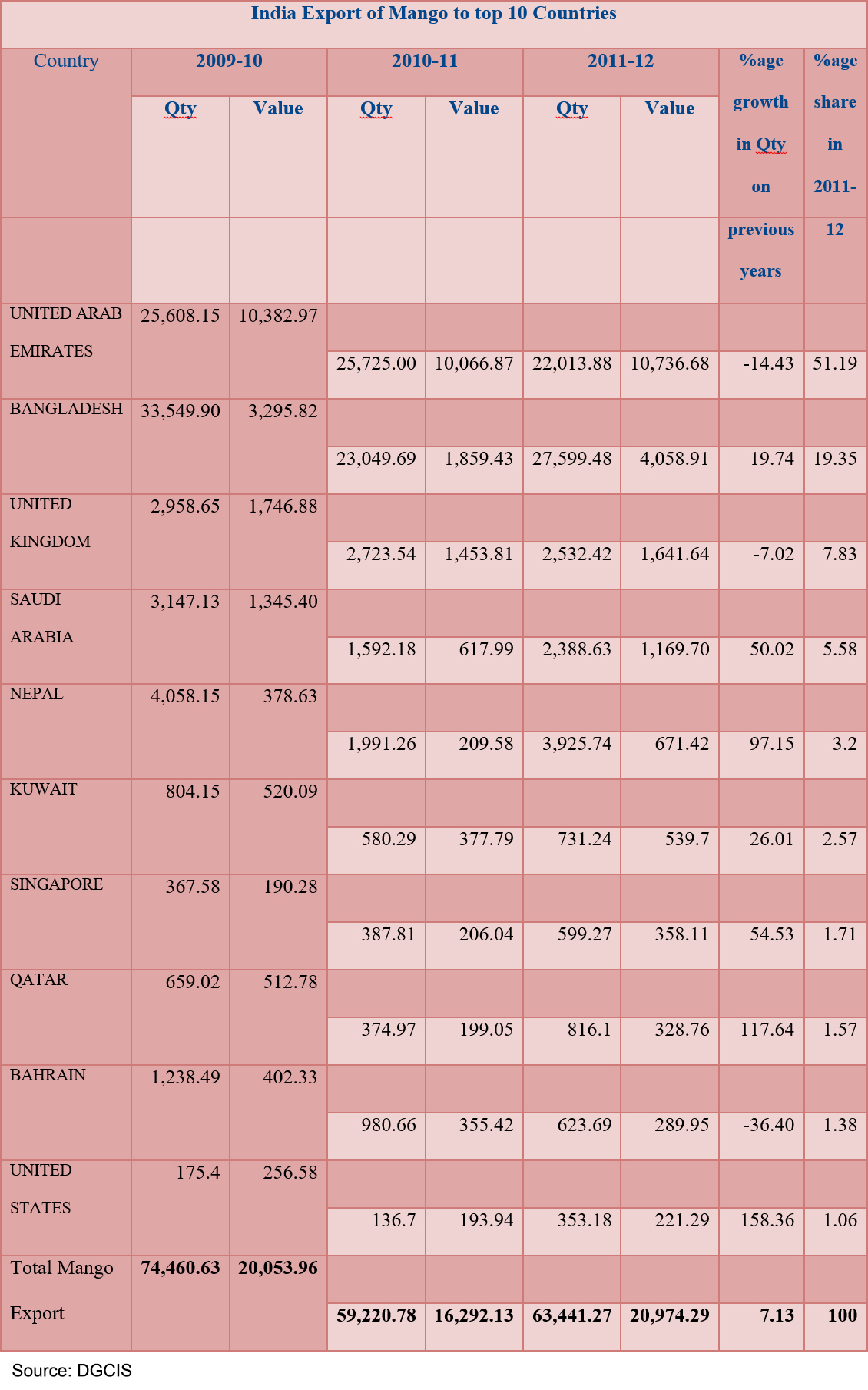
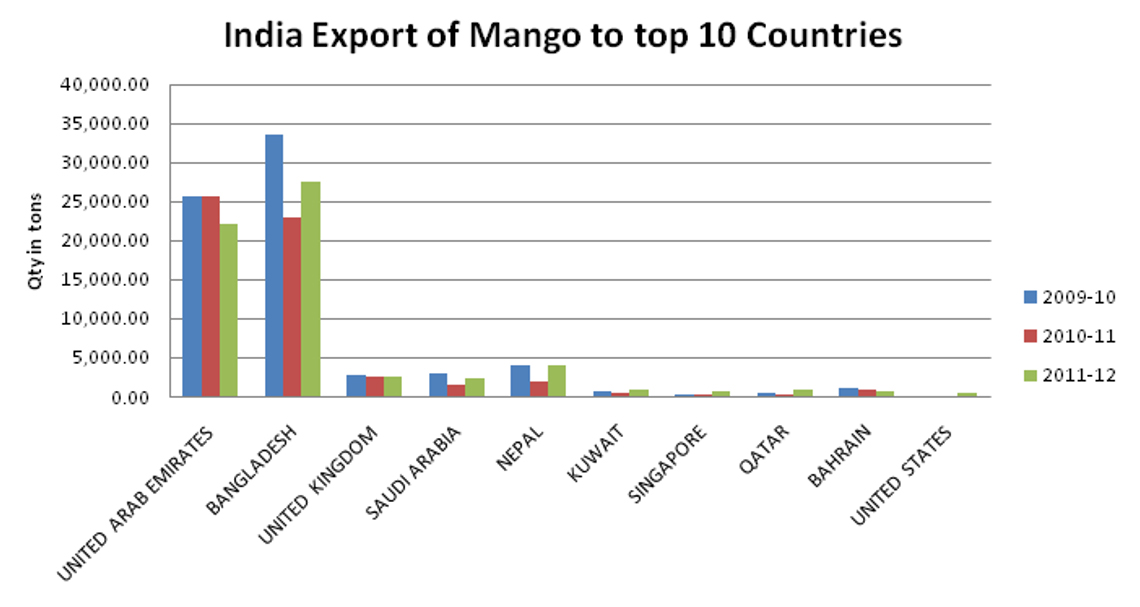
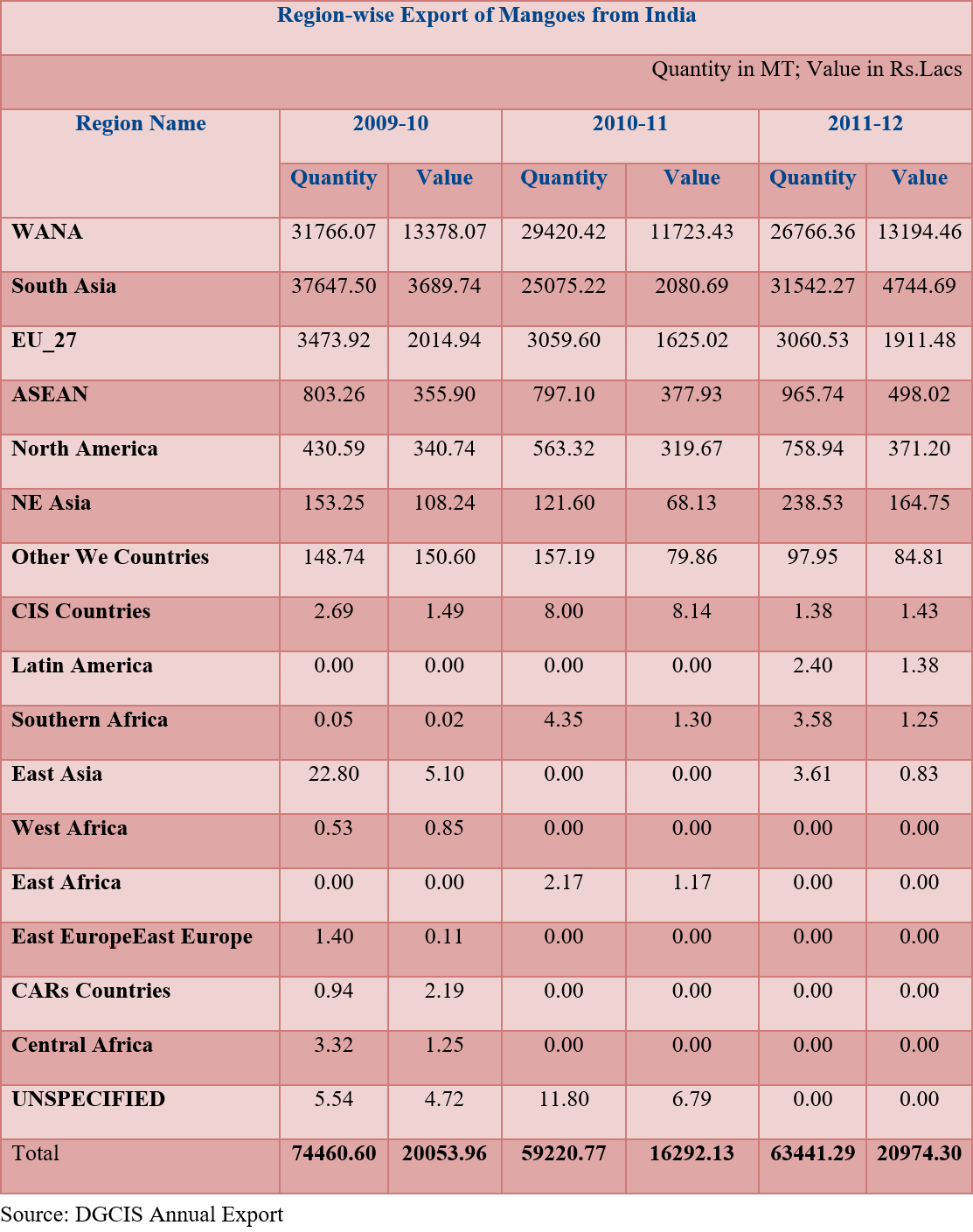
India exported 26766 tons of mangoes to WANA countries during 2011-12. The major country market of India's Mangoes in WANA region during the period were UAE (22013.88 tons), Saudi Arabia (2388.63 tons), Kuwait (731.24 tons), Qatar (816.10 tons) and Bahrain (623.69 tons) respectively.
However, there is tremendous scope for expanding exports to these countries, as India produces finest quality mangoes. India's total exports are substantial during March-April months and reduce significantly during May onwards because of competition from Pakistan. India must explore reducing costs Kesar variety of mango which is much more acceptable by increased productivity. India must target at least 50,000 to 60,000 tons of mangoes exports to WANA countries in next 4-5 years.
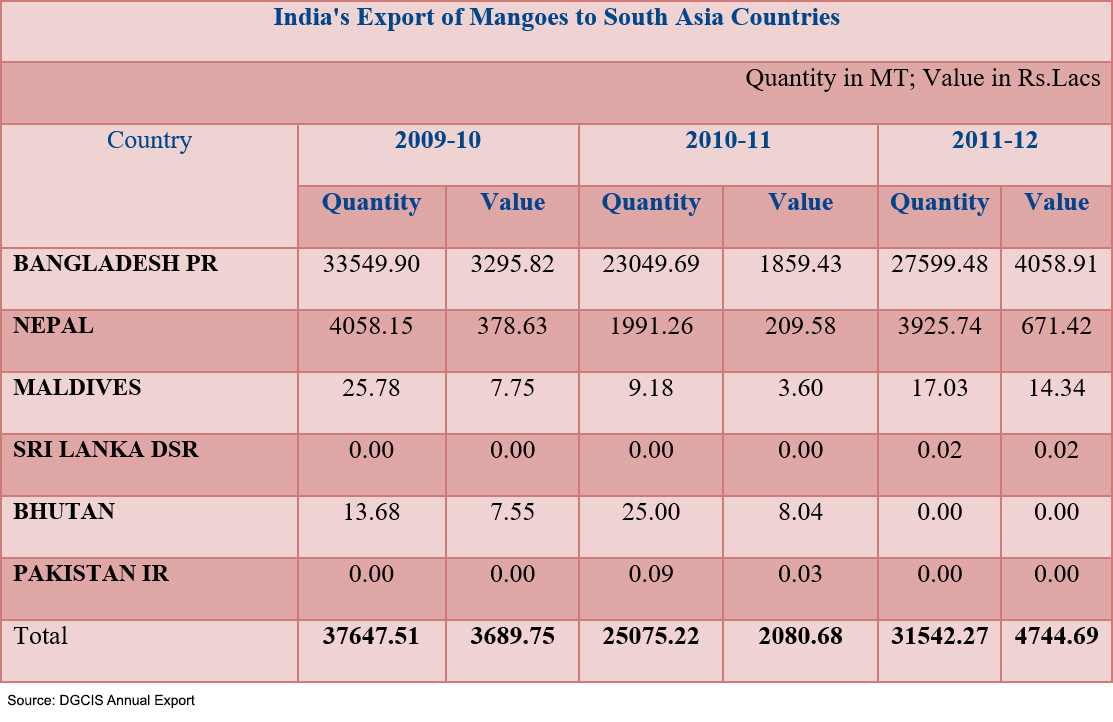
India exported 31542.27 tons of mangoes to South Asia countries during 2011-12. Bangladesh and Nepal were the major countries of South Asia and Imported 27599.48 tons and 3925.74 tons of India's mangoes during the period.
EU countries import mangoes varying from 2, 50,000 tons to 3, 50,000 tons every year. From the year 2006 there is always a 15% increase in demand every year.However only 3060 tons were exported from India during 2011-12. Out of this, maximum quantity was exported to UK (2532 tons). India is not able to penetrate other EU countries in a significant way. The exports to EU countries so far, are more or less consistent. The main reason for the absence of upsurge of export of mangoes to EU is supply of mangoes by countries like Brazil, Peru and Israel etc at cheaper rates. Thus, India must lower the cost of production by increasing productivity.
Apart from above, the other reason is that the EU market has become used to appreciate only colored mangoes. Consumers at times pay higher price for these colored mangoes. Even superior edible quality of Indian mangoes does not get much attention before colored mangoes like Tommy Atkins, Kent and Haden.
Realizing this, Research Institutes in India have bred colored varieties like ArkaAnmol, ArkaPuneet, Pusa Arunima, Ambika etc. However, their commercial productivity, acceptability in EU markets etc should be assessed on priority within definite time framework. The above mentioned colored varieties are not only attractive but have very good edible quality.
During the year 2010, ASEAN countries imported 64930 tons of Mangoesfrom world. Malaysia (23,521 tons), Singapore (16,027 tons), Vietnam (7212 tons), Indonesia (1103) and Thailand (262 tons) were the major importers. However during 2011-12, the exports of mango from India to ASEAN countries are only 353.41 tons to Malaysia and 599.27 tons to Singapore and 13 tons to Brunei. This is almost negligible as compared to the potential. However, the main importers Malaysia and Singapore are able to get mangoes at a much cheaper price from Thailand.
Therefore, the strategy for India may be to make available cheaper mangoes like Totapuri(Banglora) in Malaysian market on one hand and campaign for quality and having red blush varieties like Suvarnrekha, Kesar and Alphonso varieties on the other hand for Singapore market. Market for high quality mangoes will have to be nurtured. For competing with Thailand, variety like Totapuri (Banglora) need to be explored and require to be exported from Eastern Port of Andhra Pradesh to save on logistic costs. Side by side India must reduce the cost of production by increasing the productivity. Perhaps with this strategy, we may target a volume of 6000-8000 tons of mango in next 4-5 years.
 Following measures need to be adopted for enhancing competitiveness:
Protocol for CA and MA storage for sea shipping needs to be perfected suiting to all exportable varieties of mango, so that shelf life can be extended and we can compete with Thailand in South East Asia. Similarly, if sea shipping protocol is perfected, India can stand competitively with Australia, Kenya etc for exporting to middle east countries and can effectively enter EU market. Main emphasis needs to be laid on cost reduction by increasing productivity per hectare which is very low, so that India can compete with Pakistan and other countries which supply mangoes at lower price.