


Mango varieties usually thrive well in places with rainfall in the range of 75-375 cm/annum and dry season. Dry weather before blossoming is conducive to profuse flowering. The distribution of rainfall is more important than its amount. Rain during flowering is detrimental to the crop as it interferes with pollination. However, rain during fruit development is good but heavy rains cause damage to ripening fruits. Strong winds and cyclones during fruiting season can play havoc as they cause excessive fruit drop. Loamy, alluvial, well drained, aerated and deep soils rich in organic matter with a pH range of 5.5 to 7.5 are ideal for mango cultivation. Mango is well adapted to tropical and sub-tropical climates. It thrives well in almost all the regions of the country but cannot be grown commercially in areas above 600 m altitude. It cannot stand severe frost, especially when the tree is young. High temperature by itself is not so injurious to mango, but in combination with low humidity and high winds, it affects the tree adversely.
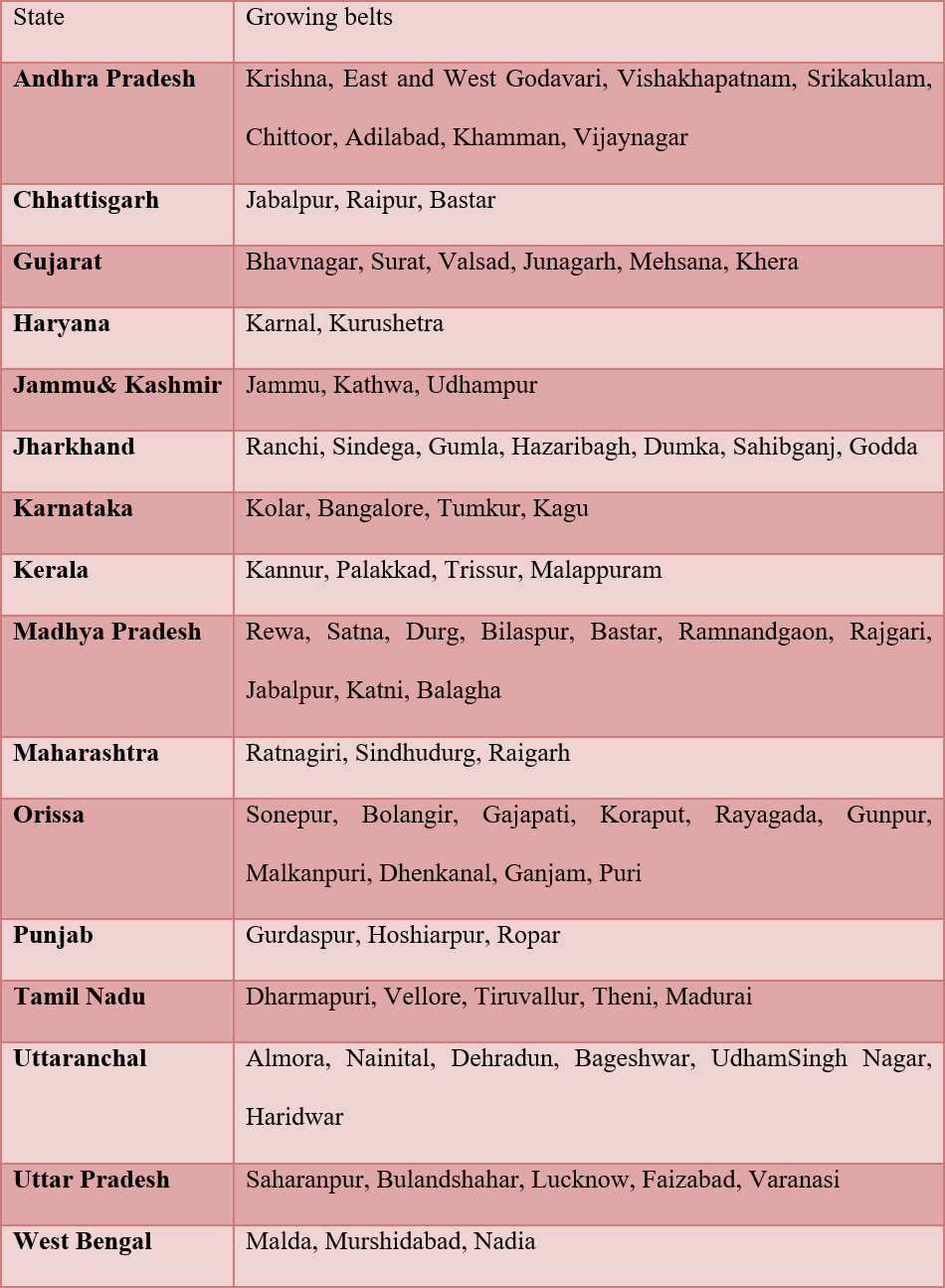
Mango is cultivated in almost all the states of India. The state-wise growing belts are given in the following:
In India, about 1,500 varieties of mango are grown including 1,000 commercial varieties. Each of the main varieties of mango has a unique taste and flavor.
Based on time of ripening, varieties may be classified as under:
| Early | - | Bombai, Bombay Green , Himsagar, Kesar, Suvernarekha |
| Mid-season | - | Alphonso, Mankurad, Bangalora, Vanraj, Banganapalli, Dashehari, Langra, KishenBhog, Zardalu, Mankurad |
| Late | - | Fazli, Fernandin, Mulgoa, Neelum, Chausa |
Amrapalli (Dashehari x Neelum), Mallika (Neelum x Dashehari), Arka Aruna (Banganapalli x Alphonso), Arka Puneet (Alphonso x Janardhan Pasand), Arka Neelkiran (Alpohonso x Neelum), Ratna (Neelum x Alphonso), Sindhu (Ratna x Alphonso), Au Rumani (Rumani x Mulgoa), Manjeera (Rumani x Neelum), PKM 1 (Chinnasuvernarekha x Neelum), Alfazli, Sunder Langra, Sabri, Jawahar, Neelphonso, Neeleshan, Neeleshwari, PKM 2 (very few of these hybrid varieties are grown commercially in the country).
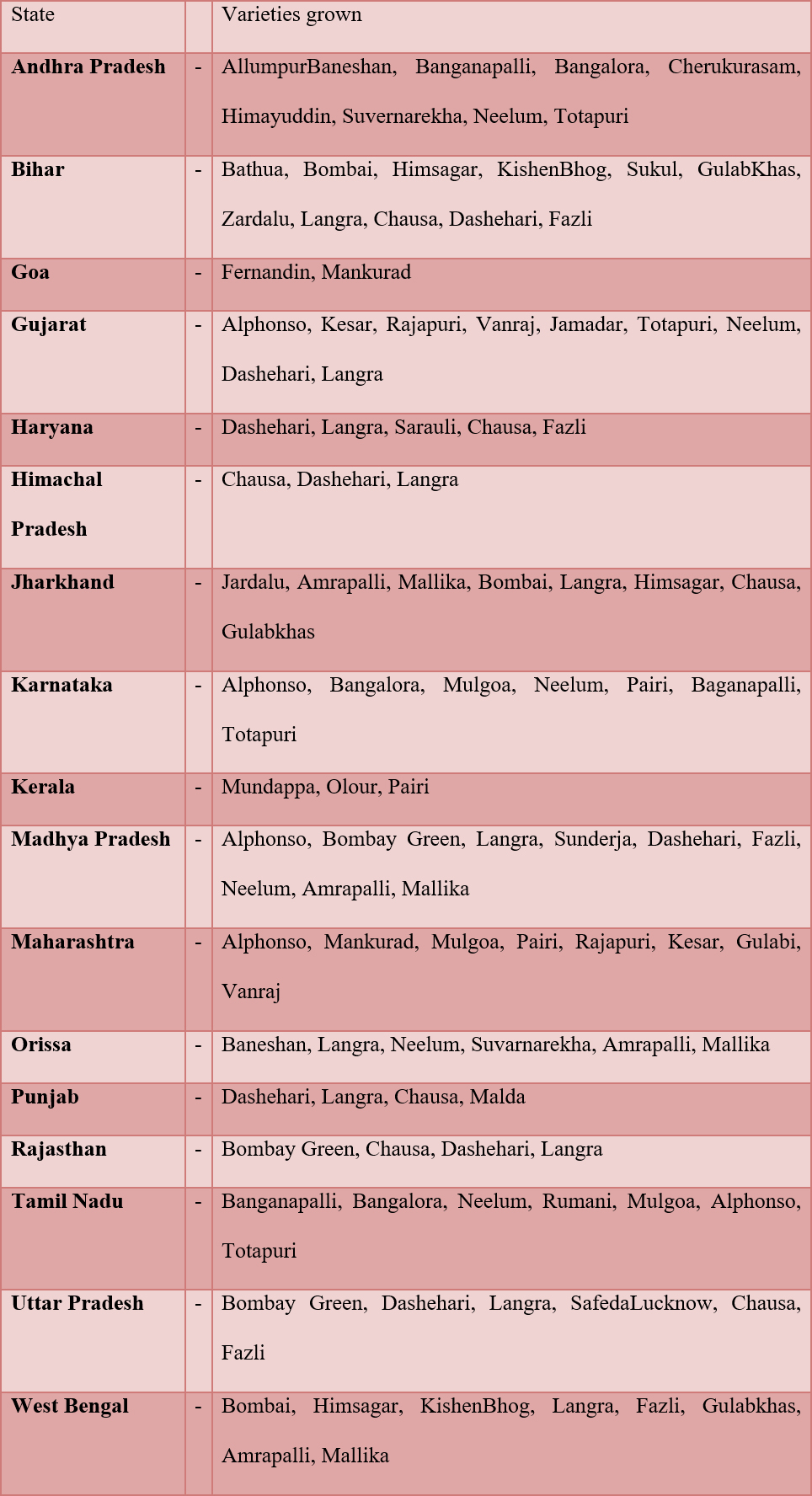
The important mango varieties cultivated in different states of India are given below:
Planting Material
Mango can be propagated from seed or propagated vegetatively. Plants are generally propagated vegetatively by using several techniques like veneer grafting, in arching and epicotyl grafting etc.
Planting Season
Planting is usually done in the month of July-August in rainfed areas and during February-March in irrigated areas. In case of heavy rainfall zones, planting is taken up at the end of rainy season.
Spacing
The planting distance is 10m. x 10m. and 12m. x 12m. in dry and moist zones respectively. In the model scheme, a spacing of 8m.x 8m. with a population of 63 plants per acre has been considered which was observed to be common in areas covered during a field study.
Training of Plants
Training of plants in the initial stages of growth is very important to give them a proper shape especially in cases where the graft has branched too low.
Nutrition
Fertilizers may be applied in two split doses, one half immediately after the harvesting of fruits in June/July and the other half in October, in both young and old orchards followed by irrigation if there are no rains. Foliar application of 3% urea in sandy soils is recommended before flowering.
The following table gives the details of fertilizer applied (depending upon the age of the plants):
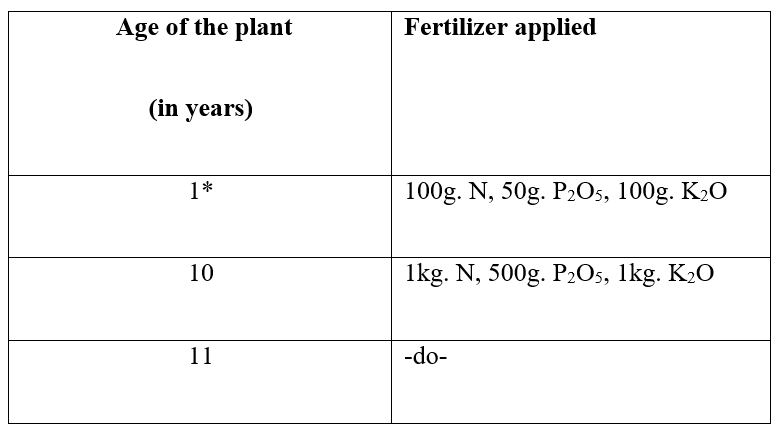
*The doses applied in the subsequent years should be increased every year upto 10 years in the multiple of the first year’s dose.
Well decomposed farm-yard manure may be applied every year. For trench application of fertilizers, 400g. each of N and K2O and 200g. of P2O5 per plant should be provided. Micro-nutrients may be applied as per the requirement in the form of foliar sprays.
Irrigation
The frequency and amount of irrigation to be provided depends on the type of soil, prevailing climatic conditions, rainfall and its distribution and lastly the age of the trees. No irrigation is required during the monsoon months unless there are long spells of drought.
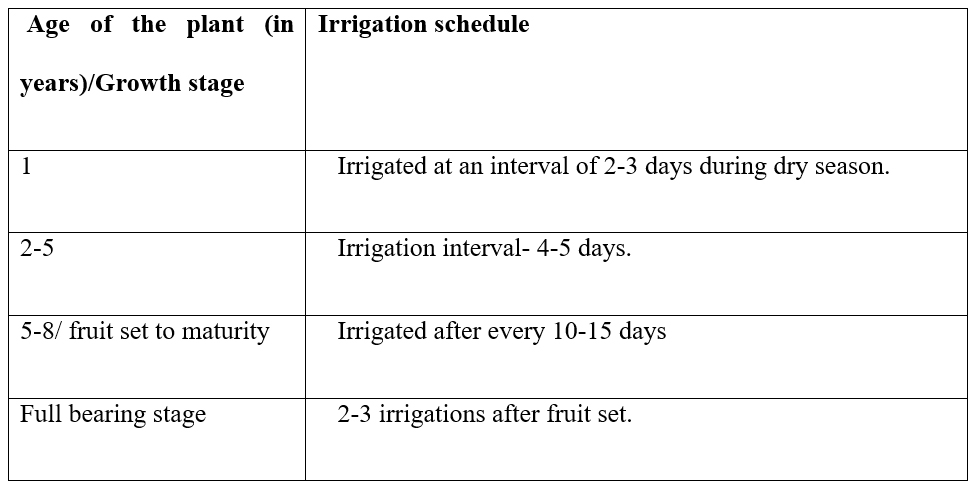
Frequent irrigation during 2-3 months prior to the flowering season is not advisable as it is likely to promote vegetative growth at the expense of flowering. Irrigation should be given at 50% field capacity. Generally intercrops are grown during the early years of plantation and hence frequency and method of irrigation has to be adjusted accordingly. The method usually followed for irrigating mango plants is basin irrigation. However, use of drip irrigation will not only reduce the water requirements but will also help in fertigation in root zones of the plants.
Intercultural Operations
The frequency and the time of intercultural operations vary with age of the orchards and existence of intercrops. The weed problem may not exist immediately after planting the mango crop but it is advisable to break the crust with hand hoe each time after 10-15 irrigations are applied. In case of monocropping, the area between the basins should be ploughed at least three times in a year i.e. during the pre-monsoon, post-monsoon period and in the last week of November
Intercropping
Intercropping can be taken up till the mango trees attain suitable height and develop canopy (at 5-6 years of age). Leguminous crops like green gram, black gram, gram etc. cereals like wheat, oilseeds like mustard, sesame and groundnut, vegetable crops such as cabbage, cauliflower, tomato, potato, brinjal, cucumber, pumpkin, bitter gourd, tinda, lady’s finger etc. and spices like chilies can be grown as intercrops. The partial shade loving crops like pineapple, ginger, turmeric etc. can be cultivated in fully grown orchards. In addition to field crops, some short duration, less exhaustive and dwarf type inter- fillers like papaya, guava, peach, plum etc. can be grown till these do not interfere with the main mango crop. It is advisable to take vegetable crops as intercrops for better returns. The average cost of intercropping would be Rs.10,000/Acre and it would yield on an average of 6 tonns/Acres.
Regulation of Bearing
Proper cultural practices like addition of fertilizers and control of diseases and insect pests may be adopted to regulate growth and bearing. Regular bearing varieties viz. Dashehari and Amrapalli may be grown. Deblossoming of the panicles with NAA @ 200 ppm. (20 g./100 l. water) during a year may help to regulate the bearing.
Regulation of Fruit Drop
Embryo abortion, climatic factors, disturbed water relation, lack of nutrition, attack of disease and pest, hormonal imbalances are the major factors that lead to fruit drop. A spray of Alar (B-Nine) @ 100 ppm or 20 ppm 2, 4-D (2g. in 100 l. water) in the last week of April or in the last week of May will control to some extent the summer fruit drop in Langra & Dashehari
The orchard starts bearing from sixth year onwards and the economic life of a mango tree exceeds 35 years. Yield of fruits varies considerably according to the variety, climatic conditions, plant population etc. On an average, the yield ranges from 5 to 9 tonns/acre. Grafted plants start bearing early.