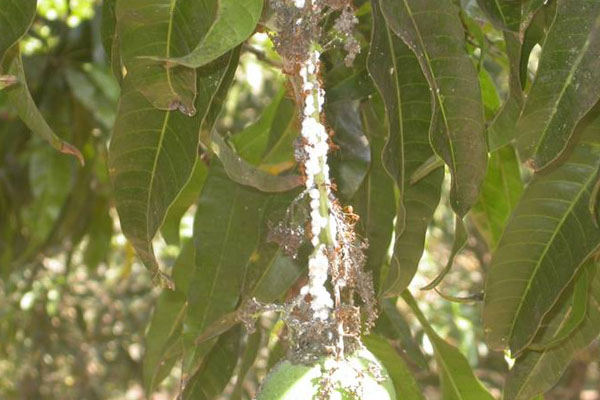
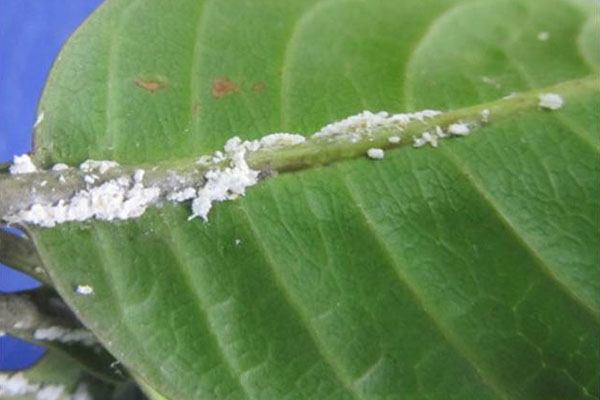
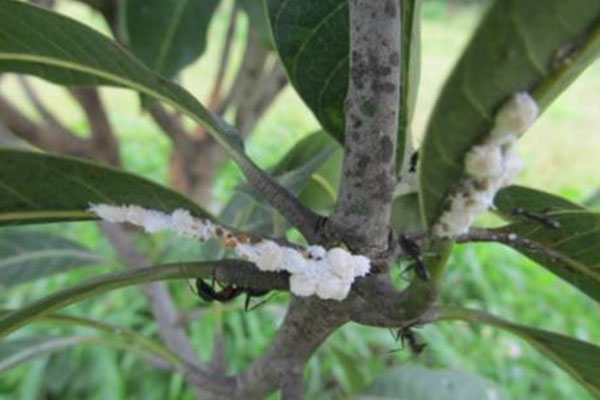
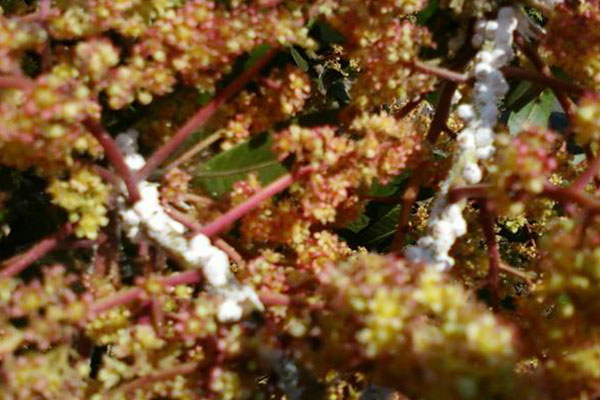
The Presence of pinkish nymphs and adult mealybugs covered with white waxy filaments are seen on leaves, inflorescence, branches and fruits.
Adults and nymphs both sucks the plant sap and reduce the plant growth, destroy inflorescence and causes fruit drop. Mealy bug excretes honey dew, a sticky substance, which facilitates the development of sooty mould fungi (Maliola mangiferae & Capnodium mangiferae). The female insect crawls down in the month of April/May to lay the eggs in soil. The eggs hatch in the following month of November/December and crawls up the tree.
Flooding the orchard in the month of October and deep ploughing in November, fastening of alkathene 25 cm wide sheet (400 gauge) afterwards mud plastering of trunk at 30 cm above the ground in the middle of December, loosening of soil around the tree trunk and mixing of Chlorpyriphos dust (1.5%) @ 250 g per tree helps in reduction of mealy bug population. This dust can also be applied below the alkathene band on tree trunk and soil. Spraying of Propanophos (0.05%) or Imidachlopid (0.005%) for control of nymphs already made the way up to tree.
Flooding of orchard with water in the month of October kill the eggs.
Ploughing of orchard in November.
Raking of soil around tree trunk to expose the eggs to natural enemies and sun, removal of weeds
Fastening of alkathene sheet (400 gauge)/grease band of 25 cm wide afterwards mud plastering of trunk at 30 cm above the ground in the middle of December.
In July-August destruction of infested fallen leaves with scales.
Raking of soil around tree trunk to expose the eggs to natural enemies and sun, removal of weeds and releasing 10-15 grubs.
Releasing 10-15 grubs of cocinellid predator, C. montrozieri per tree.
Apart from B. bassiana, coccinellid beetles (predator), Minochillus sexmaculatus, Rodolia fumida and Suminus renardi are natural bio-control agents of this pest.