Three different species of hoppers are common.
Nymphs and adults are seen on younger leaves and inflorescence.
Nymphs are pale yellow and adults vary in size from small to large depending on the species. Adults may be dark with wavy lines on wings and three spots on scutellum or light brown with dark spots on the vertex and two spots on scutellum or light brown with two spots on scutellum.
Presence of honeydew secretion on leaves, inflorescence and on fruits with sooty mould development is common.
Characteristic clicking sound could be heard during higher infestation periods of jassids produced by the movement of jassids amidst leaves.
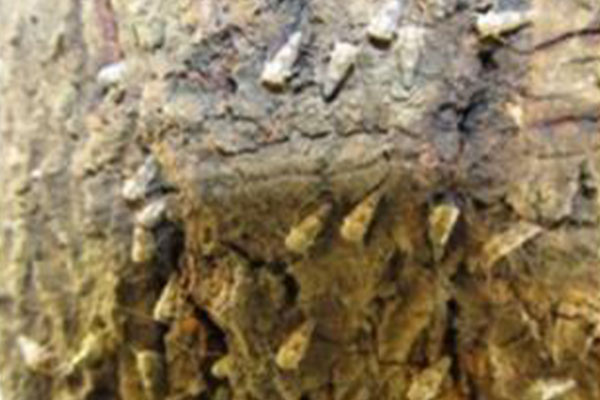
Hoppers shelter in the cracks and crevices of the barks on the tree during off season.
In order to control mango hoppers, first spray of imidacloprid (0.005%, 0.3 ml per litre of water) should be done at early stages of panicle formation, if hopper population is more than 5 per panicle. The second spray of thiamethoxam (0.005%, i.e., 0.2 g per litre of water) or acephate (1.5 g per litre of water) should be carried out after fruit set. If substantial hopper population still persists, third spray of carbaryl (0.15%, i.e., 3g per/litre of water) should be done before maturity of fruits. Synthetic pyrethroids such as cypermethrin, permethrin, fenvalerate and deltamethrin should not be sprayed in mango as they are harmful to human health
Pruning of dense orchards in the month of December, orchard sanitation and field sanitation, rouging.
Keep the nursery area clean, free of weeds and grasses to keep away the grasshoppers.
Removal of weeds and alternate host plants like hibiscus, custard apple, guava etc.
Avoid dense plantings, maintained open canopy, prune overcrowded overlapping branches after rainy season.
Avoid excess use of nitrogenous fertilizers.
Smoking of orchards by burning of crop residues/cow dung cake during evening hours.
Orchardists are advised not to spray if more than 50% flowering has already occurred because it will affect the pollinator activity leading to low fruit set.
Biological Control
Application of bio-agents, Metarhiziumanisopliae@ 1x 10⁸ cfu/ml or Beauveriabassiana@108 cfu /ml on tree trunk once during off season and twice at 7 days interval during flowering season.