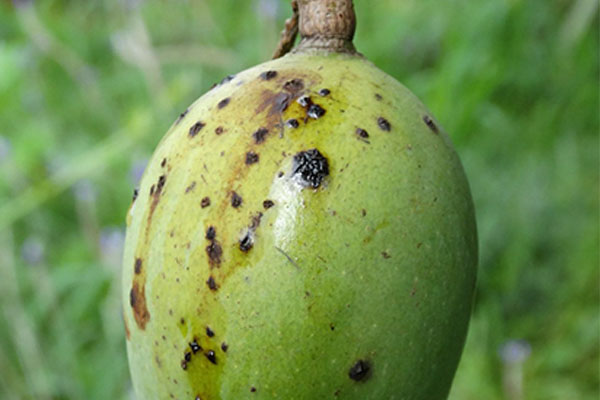
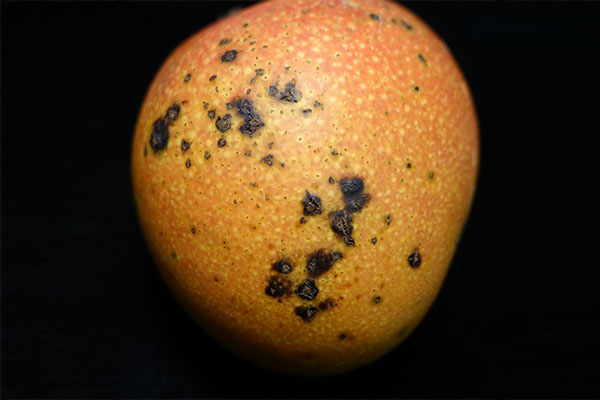
On green fruits infection remains latent and largely invisible until ripening and hence cannot be sampled. On ripe fruits anthracnose infection causes sunken, prominent, dark brown to black decay spots before or after picking. Fruits may also drop from trees prematurely. Fruits can show symptoms, resulting in infection. Such infection causes fruits to develop wide and deep cracks on the skin that extend into the pulp. Lesions on fruits may also produce conspicuous, pinkish-orange spore masses under wet conditions.
Infection on blossom could be reduced effectively by 2 sprays of Carbendazim (0.1%) at 15 day intervals. Its foliar infection can be managed by spray of Copper oxychloride or Copper hydroxide (77WP) @ 0.3%, while latent infection of the pathogen on fruits could be reduced by pre-harvest sprays of Thiophanate methyl (70WP) or Carbendazim (50WP) @ 0.1%. Post-harvest infection of this pathogen can be managed by post-harvest dip of fruits either with hot water alone (52 ± 1°C) or hot water in combination of fungicides, Thiophanate methyl or Carbendazim (0.05%) for ten minutes.
Diseased leaves, twigs, gall midge infected leaves and fruits, should be collected and burnt.
Covering the fruits on tree, 15 days prior to harvest with news or brown paper bags.
Glomerella cingulata (Anthracnose on fruits) can be biologically controlled by applying Trichoderma harzianum or Pseudomonas fluorescens at 2.5 kg/ha mixed with 50 kg of FYM or as a 1% foliar spray (10 g/L water) at 10–15 day intervals.