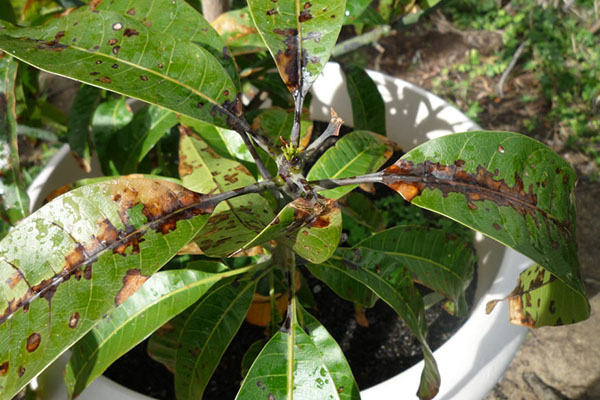
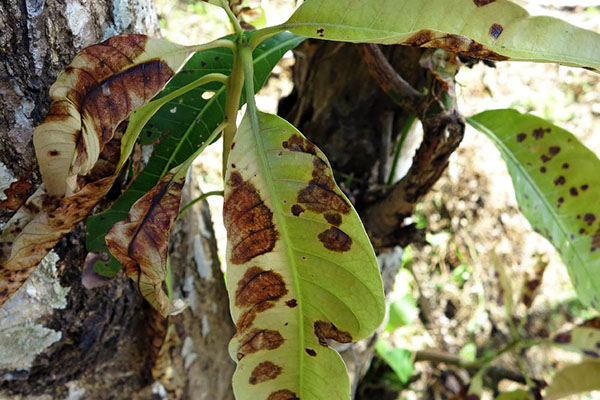
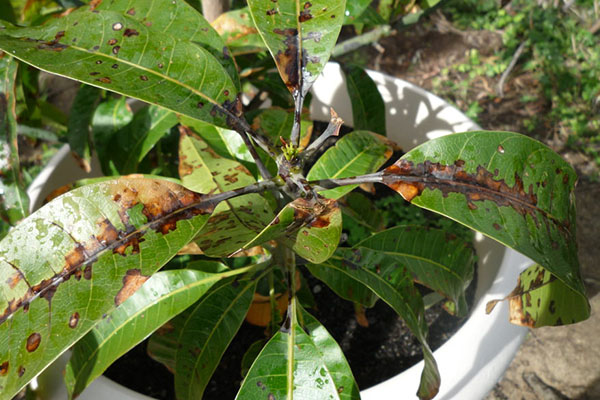
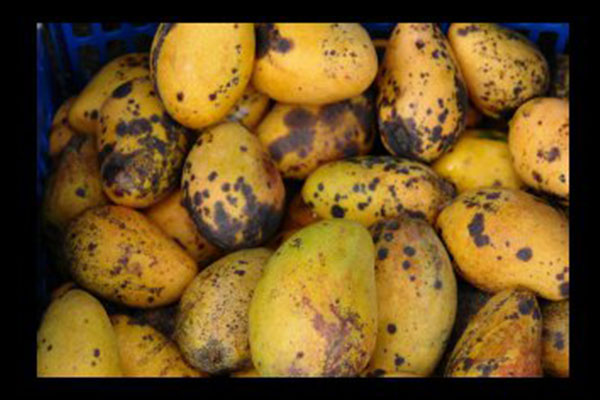
Disease produces leaf spots, withered tips and twig blight.
Small dark brown or black spots appear on newly emerged leaves.
Panicles turn black in colour and dry off. When entire inflorescence is damaged during severe infection no setting of fruits takes place.
Infection on blossom could be reduced effectively by 2 sprays of Carbendazim (0.1%) at 15 day intervals. Its foliar infection can be managed by spray of Copper oxychloride or Copper hydroxide (77WP) @ 0.3%, while latent infection of the pathogen on fruits could be reduced by pre-harvest sprays of Thiophanate methyl (70WP) or Carbendazim (50WP) @ 0.1%. Post-harvest infection of this pathogen can be managed by post-harvest dip of fruits either with hot water alone (52 ± 1°C) or hot water in combination of fungicides, Thiophanate methyl or Carbendazim (0.05%) for ten minutes.
Diseased leaves, twigs, gall midge infected leaves and fruits, should be collected and burnt.
Covering the fruits on tree, 15 days prior to harvest with news or brown paper bags.
Disease may be reduced by removal of diseased parts from the tree and its destruction by burning.
Effect of heat treatment in combination with fungicides and plant extract to control storage anthracnose of mango fruits. Dip treatment with propiconazole at 500 ppm and Cannabis sativa extract were most effective against anthracnose. Heat treatment at 45°C enhanced the curative properties of pesticide and extract along with maintaining shelf life of mango at room temperature.